
Customer acquisition
Customer Acquisition: How Local Businesses Turn Search Into Sales
Getting found is one thing. Getting chosen is another.
Every day, people search for businesses that can solve a problem. They need a plumber. A mobile notary. A contractor. An attorney. Someone who can do the job, in the right location, at the right time.
Some businesses capture that demand. Others never enter the customer's consideration. The difference isn't always advertising, reputation, or service quality. Often, it's the path between the customer looking and the business getting contacted.
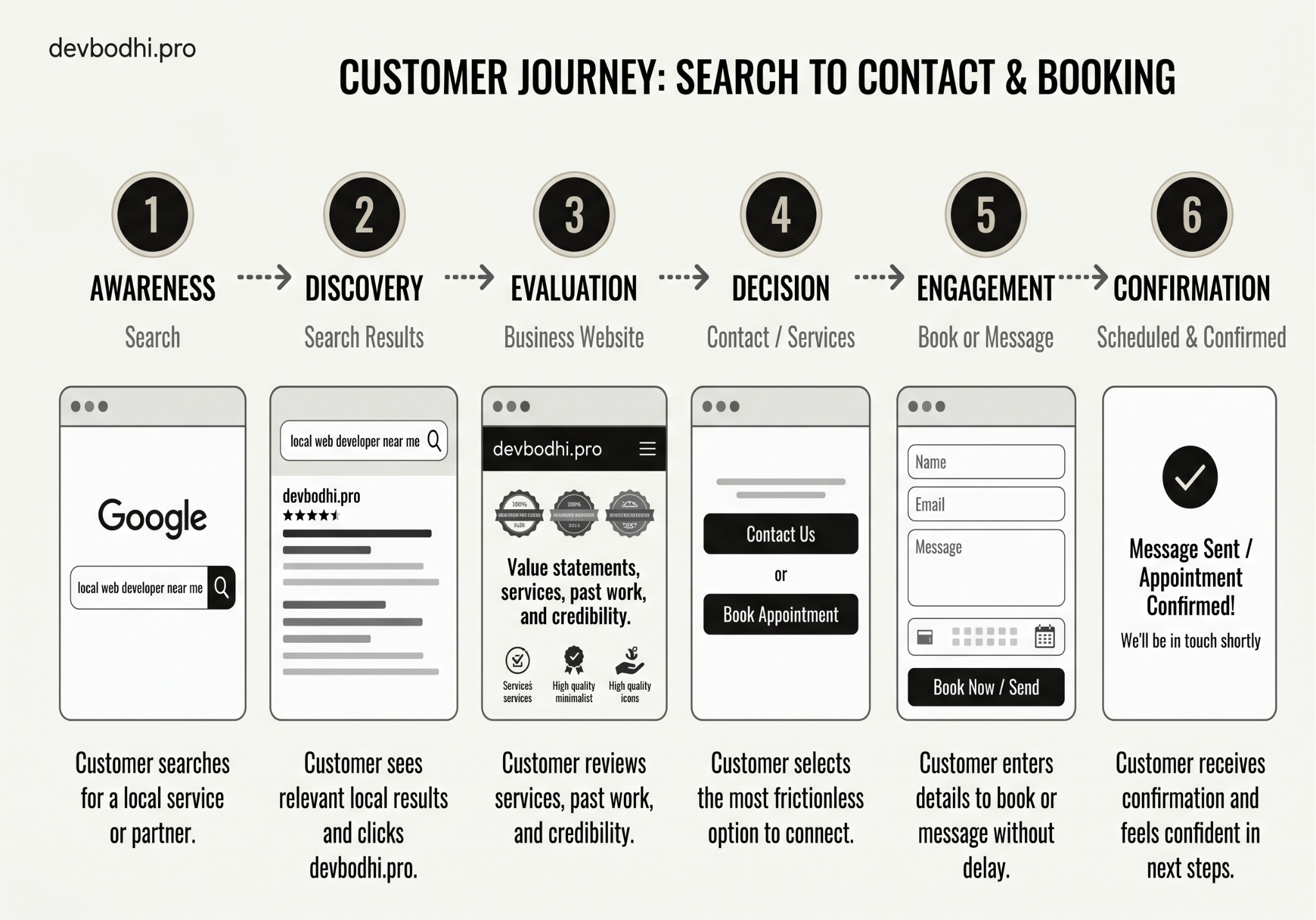
Five connected steps. Each has a job. Each can lose a potential customer.
What is customer acquisition?
Customer acquisition is the process of turning prospective buyers into paying customers. It includes how people discover a business, what makes them consider it, how they evaluate its credibility, and what moves them to make contact and purchase.
For a local service business, that process might begin with a Google search and end with a booked appointment. The business doesn't need to manufacture the customer's need. The need already exists. The opportunity is to be found when that need becomes active—and to make choosing the business straightforward.
A useful strategy starts with three questions: Who is already looking for this service? What determines which business they choose? What stands between that decision and a completed sale?
The customer journey: From search to contact
Customers rarely think in terms of marketing funnels. They have something they need done. They search, compare, make a judgment, and act.
1. Search: The customer has a need
Someone searches for “mobile notary near me” or “emergency roof repair.” That search represents potential demand. But someone researching roof replacement costs may be months away from hiring, while someone searching after a storm may need help immediately. Different intent requires different information.
2. Relevance: Does this business do what I need?
The customer encounters a search result, listing, or website. They need to recognize that the business offers the right service in the right location. Clear service descriptions, accurate service areas, and specific headlines establish relevance.
3. Trust: Is this business worth contacting?
Once the business looks relevant, the customer evaluates whether it seems capable and reliable. Reviews, photographs, credentials, examples of work, and straightforward explanations help. Trust isn't created by claiming to be the best. It's established through credible evidence.
4. Contact: How do I get started?
The customer is ready to act. A buried phone number, broken booking link, or lengthy form can lose the opportunity. A clear call, text, quote, or booking option removes friction.
5. Customer: Does the business complete the sale?
An inquiry isn't revenue. Someone still needs to answer, quote accurately, schedule the work, and follow through. Acquisition ends when a customer is acquired—not when a form is submitted.
Lead generation vs. customer acquisition
Lead generation produces opportunities. Customer acquisition converts them into customers.
A website that generates 40 inquiries may be doing well at lead generation. If only two become customers, investigate why: lead quality, pricing, response time, the offer, or competition. More traffic won't necessarily fix those problems.
| Lead generation | Customer acquisition |
|---|---|
| Website inquiries | New paying customers |
| Phone calls and texts | Completed bookings or sales |
| Form submissions | Lead-to-customer conversion |
| Cost per lead | Customer acquisition cost |
| Inquiry volume | Revenue and customer value |
Why customer acquisition starts with market research
A common mistake is choosing marketing tactics before establishing what the market needs. A business launches a website, buys ads, and publishes content. Only afterward does it discover that its most valuable services aren't prominent, competitors dominate relevant searches, or customers want different information.
That's backward. Investigate the opportunity first. Which services have identifiable local demand? Which searches signal buying intent? Who currently appears? What do competitors promise? What questions remain unanswered?
Two mobile notaries can face very different markets. One may see demand for hospital visits and estate documents. Another may find stronger opportunities in real estate closings and general notarizations. A generic website treats them the same. Market research shows where the strategy should differ.
Search visibility: Getting in front of existing demand
Search engines are useful because people actively describe what they want. “Same-day appliance repair” signals a different need from “appliance repair cost.” Local SEO helps a business become discoverable through its website, Google Business Profile, service pages, and relevant search signals.
The objective isn't ranking for every keyword. It's appearing for searches that match services the business can profitably deliver.
What makes a useful local service page?
Answer the immediate questions. What service is offered? Where? What problems does it address? What should the customer expect? How do they start?
For emergency work, speed and availability may matter most. For estate planning, professional credibility, process, and qualifications may carry more weight. The page should reflect the buying situation—not simply repeat a keyword.
Website conversion: Turning visitors into inquiries
A website can be attractive and still perform poorly as a customer-acquisition tool. Good design helps, but appearance alone doesn't explain why someone acts.
- Immediate clarity: State the service and service area near the top.
- Mobile usability: Keep essential information and contact actions accessible.
- Credible proof: Show real reviews, qualifications, or examples.
- Useful information: Answer questions that delay contact.
- Direct contact: Offer a clear call, text, quote, or booking option.
- Reliable follow-up: Make sure inquiries reach someone who responds.
Not every website needs complicated features. It needs to help the customer make a decision.
Trust is part of the acquisition system
People compare businesses before contacting one. They may check reviews, photographs, credentials, service descriptions, and overall presentation. A capable business can lose that comparison when its online presence leaves important questions unanswered.
Trust isn't a matter of decorating a page with badges. The evidence has to be real and relevant. A contractor might show completed projects and licensing. A notary might clarify appointment requirements. An attorney might explain credentials and consultation procedures.
Give the customer enough information to make a confident decision.
Which customer acquisition strategies work best?
There isn't one strategy that works equally well for every business. The right channel depends on customer behavior, competition, margins, urgency, and the economics of acquiring a sale.
Local SEO
Useful when customers actively search for the service. Google Business Profile, accurate listings, relevant service pages, and search-focused content help businesses compete for existing demand.
Paid search advertising
Useful for faster visibility or testing specific services and offers. Its economics depend on click costs, lead quality, conversion, and customer value.
Reviews and referrals
Useful when reputation influences selection. Genuine recommendations can reduce uncertainty before contact.
Educational content
Useful when customers research costs, processes, questions, and alternatives before buying. Content should connect naturally to relevant services.
Follow-up and automation
Useful when inquiries are missed, delayed, or inconsistently handled. A reliable callback process may be worth more than another promotional campaign.
Find the weak point before spending more
Businesses frequently assume they need more traffic. Sometimes they do. Other times, existing traffic is being wasted.
| What you're seeing | What to investigate |
|---|---|
| Few relevant visitors | Search visibility, competition, demand, indexing |
| Visitors but few inquiries | Relevance, trust, mobile usability, contact options |
| Inquiries but few sales | Lead quality, response time, pricing, follow-up |
| High advertising costs | Targeting, conversion, margins, customer value |
| Strong referrals but weak online acquisition | Search presence, positioning, digital credibility |
These are hypotheses to investigate, not automatic conclusions. A high bounce rate doesn't necessarily mean failure; someone may have found the phone number and called. Measurement needs context.
How to measure customer acquisition
Customer Acquisition Cost (CAC) = Total Acquisition Costs ÷ New Customers Acquired
If a business spends $1,500 on relevant marketing and sales activity and gains 10 customers, its average acquisition cost is $150. Whether that's good depends on what those customers are worth.
A company earning $90 in contribution margin from a one-time job has different economics from one earning $2,000 from a customer relationship.
- Qualified inquiries by channel
- New customers acquired
- Inquiry-to-customer conversion rate
- Customer acquisition cost
- Average sale value and contribution margin
- Repeat business and customer lifetime value
- Time between inquiry and response
Small businesses don't necessarily need elaborate reporting. They need enough reliable information to understand which activities produce worthwhile business.
A practical customer acquisition model for local businesses
- Establish the opportunity. Identify services, customer types, demand, competitors, and commercial value.
- Build around buying behavior. Present the information customers need in the order they need it.
- Make the business discoverable. Develop the right search presence, listings, service pages, and content.
- Remove contact friction. Make calling, texting, requesting a quote, or booking straightforward.
- Measure and improve. Follow inquiries through to customers and investigate where opportunities are lost.
This is a foundation, not a promise of rankings or guaranteed revenue. Results depend on the market, competition, the offer, and the business's ability to deliver.
The bottom line
Customer acquisition isn't about convincing everyone to buy. It's about making a business visible and credible to people who already have a reason to consider it.
Search brings the opportunity. Relevance earns consideration. Trust supports the decision. Contact creates the conversation. The business completes the sale.
At devbodhi, we start by researching local markets and identifying real commercial opportunities. Then we build the digital foundation around how customers actually find, evaluate, and contact businesses.
Not websites for the sake of having websites. A better path from existing demand to actual customers.